Your people are not the problem. The conditions are.
You invest in your people. Leadership programs, wellbeing apps, resilience training. Then you ask them to do their most complex thinking in a space nobody has ever examined.
You have seen it. You just called it something else.
Most organisations are already paying for their environment. It simply shows up under other names, on other budgets, and nobody connects it back to the space.
- The whole floor hits a wall at three in the afternoon.
- Your best people book meeting spaces just to hear themselves think.
- The wellbeing program had great feedback, and nothing changed.
- People resist coming into the office, and cannot tell you why.
- Burnout gets treated as a people problem, one person at a time.
Australian codes of practice name hazardous physical working environments as a psychosocial hazard. Lighting, noise, air, thermal discomfort and ergonomics are part of the risk. Most organisations read that line, decide it means the warehouse, and move on. It also means the floor where your highest paid people do their most complex thinking.
Four ways in, depending on where you are.
The Silent PartnerThe environment as the overlooked performance variable
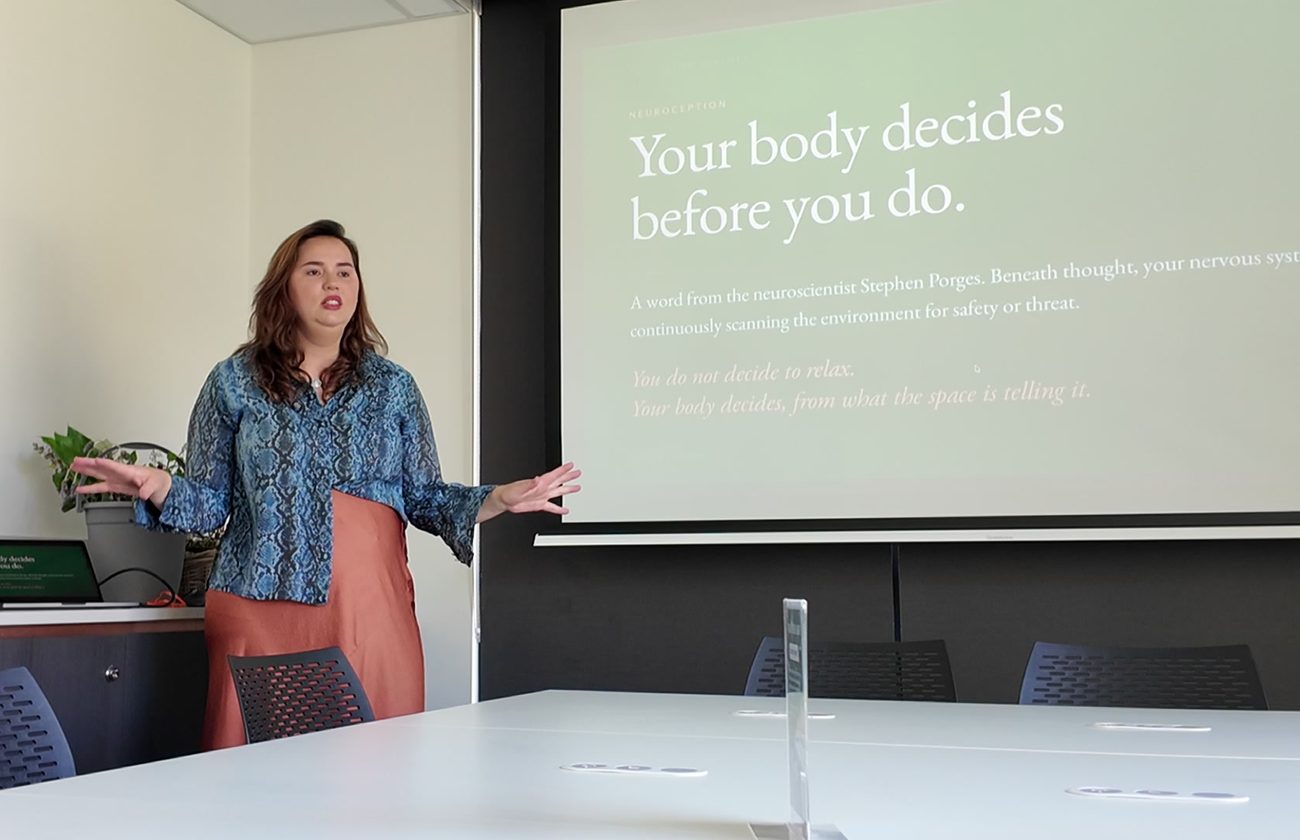
A keynote that changes how an audience of leaders sees the spaces their people work in. The science in plain language, the evidence behind it, and the moment everyone recognises their own workplace.
For conferences, leadership events and offsites.
The Human Performance LensTeaching your leaders to see what the space is doing
A working session for leadership, people and culture, and facilities teams. They leave able to read their own environment through six signals, and with a shortlist of what to change first.
For leadership teams and people and culture functions.
Environmental Performance AuditWhat your environment is asking from your people
A structured assessment of your workplace. I read the space through light, sound, air, temperature, movement and proximity, speak with the people who work in it, and hand back a clear account of what it is costing and what to change, in order.
For organisations ready to act, or preparing for psychosocial risk review.
Strategic AdvisoryA second pair of eyes on the decisions that shape the space
Guidance across workplace briefs, fit-outs, relocations and organisational change, so the human nervous system is in the brief from the start rather than an afterthought at handover.
For organisations planning a move, a fit-out or a restructure.
From first conversation to clear changes.
Conversation
What you are seeing in your people, and what you want to be different.
Read the space
On site, through six signals, and with the people who work in it every day.
The account
What your environment is asking from your people, and what that is costing you.
The changes
A prioritised list, most of it far cheaper than people expect, starting with the first week.
In award-winning classrooms designed for neurodivergent children, teachers reported the children's behaviour had changed within weeks. Adults are not exempt. They are just better at blaming themselves for it.
I do not redesign your space. I teach your people to read it.
Most workplace programs change the space and hope behaviour follows. I work the other way.
When people understand how their body responds to light, sound, air and clutter, they start making better decisions about when they focus, when they move, and when they step outside. They align what they do with where they do it. The space stops working against them, because they finally know how to use it.
Companies spend millions on the fit out and almost nothing on teaching people how to use it. That is the gap I close.
This is what the keynote opens and the workshop makes practical. I am not solving it for them. I am giving them the tools to solve it themselves, in this building and in the next one.
This workshop changed the way I see my workspace.
I learned that comfort and productivity can start with simple things: a comfortable chair, a purposeful desk, fresh air, and bringing nature into the space, even something as simple as a vase of flowers.
I also realised how an organised, welcoming environment can create more clarity, reduce the feeling of accumulated tasks, and help me work with less stress.
I left with simple changes I could actually apply, and a completely different awareness of how the space around me can influence the way I work and feel.
Anne
Before your workshop my workspace was quietly draining my energy and productivity without me fully realising it. The lack of natural light, poor air circulation and a desk constantly cluttered with things made it hard to think clearly and stay focused.
I also had no real structure in my day, no intentional breaks, no stepping outside to get some sun and reset. I would just push through, and by the end of the day I felt exhausted without feeling accomplished.
The moment I realised my space was affecting my work was when I noticed how unmotivated I felt just sitting down at my desk. It did not feel like a place where good work happened.
What is different now is that I am more intentional about my environment, my breaks and how I show up each day. Small changes made a big difference to how I feel and how I finish my day.
We often focus on strategy and productivity tools, but overlook the space we actually work in. Fixing that changed everything for me.
Leti, TACT Dream
Questions organisations ask first.
Is the physical work environment a psychosocial hazard in Australia?
Yes. Australian codes of practice, including the SafeWork NSW code, name hazardous physical working environments as a psychosocial hazard. Lighting, noise, air quality, thermal discomfort and ergonomics are part of psychosocial risk, not only comfort.
How does the office environment affect productivity and focus?
The body reads a space before the mind forms a thought. Unwanted noise has to be filtered, harsh or poor light can affect alertness and sleep, and exposure can hold people on low-grade alert. That filtering can be paid for in attention, energy and decision quality, often by mid-afternoon.
What is an environmental performance audit?
A structured assessment of a workplace through six signals: light, sound, air, temperature, movement and proximity. It includes time on site and with the people who work there, and ends with a clear account of what the environment is costing and a prioritised list of changes.
Who is The Silent Partner keynote for?
Conferences, leadership events and offsites where leaders want to understand the overlooked variable in performance and wellbeing: the physical environment their people work in.
Does this apply to neurodivergent employees?
Yes, and it began there. The work grew from award-winning classrooms for neurodivergent children. Environments designed for a wider range of nervous systems work better for everyone, because there is no typical nervous system.
Do you work outside Australia?
Yes. Etienny is based in Adelaide and works internationally, in English and Portuguese.
What is your environment asking from your people?
Send me the floor plan and a photograph of where your team sits. It is usually enough to start a very useful conversation.