The Book · Available now

The home you raise your children in is shaping who they are becoming.

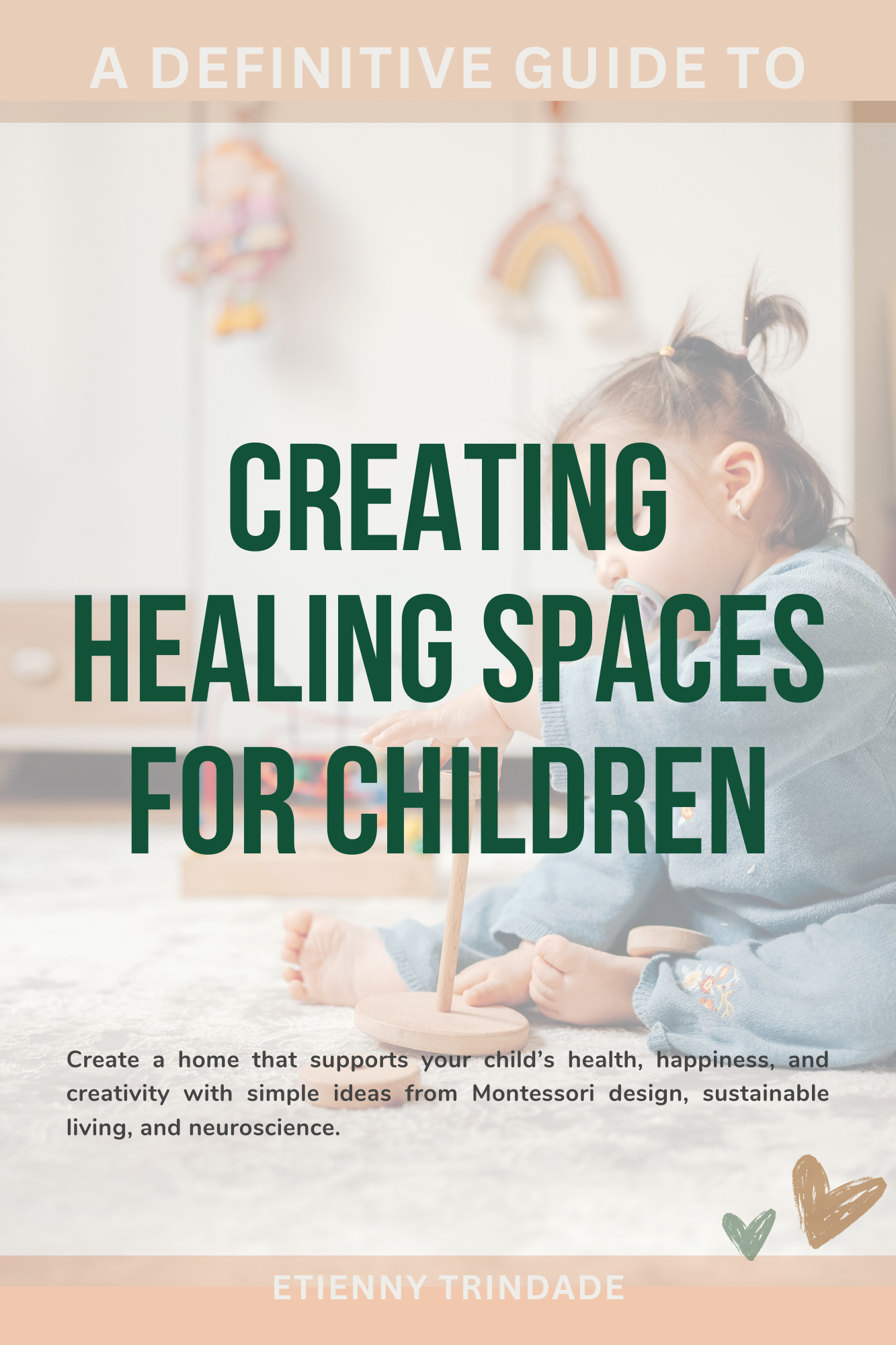
Creating Healing Spaces for Children is a definitive guide for parents and educators who want to design homes and classrooms that quietly support a child's regulation, focus, sleep, and emotional wellbeing, using simple ideas drawn from Montessori design, sustainable living, and neuroscience.

Paperback on Amazon Australia · PDF instant delivery to your inbox

Creating Healing Spaces for Children, book cover

If your child can't settle, can't focus, falls apart at the smallest thing, sleeps poorly, or seems wired by 5pm, the answer may not be another routine, another diet, or another behavioural strategy. The answer may be sitting around them, hour by hour, asking them to regulate something their nervous system was never meant to regulate.

Who this book is for

For the parents, carers, and educators who keep asking: "Why is this so hard?"

If any of these feel familiar, this book is for you.

You are a parent

You've tried every routine, every chart, every calmer-parent course. The mornings still unravel. Bedtime still takes ninety minutes. Your child still seems wired by 5pm and you can't work out why. The answer may not be parenting harder. The answer may be in the room.

You are an educator

You've watched the same student behave like two different children in two different rooms. You know it's not the curriculum. It's not the teacher. Something about the space changes everything, and nobody is talking about it. This book gives you the language for what you've been seeing.

You support neurodivergent children

You already know they need different things. What most resources won't tell you: many of those needs are environmental, not behavioural. The right room can lift the floor under a child's day. The wrong room can quietly empty their tank by morning tea.

What is inside

Everything most parenting books skip, because environment is harder to write about than behaviour.

The book walks you through the science of how a child's developing nervous system is shaped, every hour, by light, air, sound, sensory load, ownership of space, and the rhythms of the home. Then it shows you what to change, in plain language, for the rooms you already have.

You will not be asked to renovate. You will not be asked to buy a new bed, a new colour scheme, or a new house. You will be asked to look at the rooms differently, and to understand, for the first time, what they have been asking of your child every day.

  • ◆ Why the wrong light at 7pm makes bedtime three times harder
  • ◆ The single change to a child's bedroom that drops cortisol within days
  • ◆ How visual clutter is processed by the brain (and why "tidying up" misses the point)
  • ◆ The Montessori principle most homes break by accident
  • ◆ Why neurodivergent children need ownership of space (and how to give it to them in a shared bedroom)
  • ◆ What the research on classroom design (Salford HEAD project) tells us about every room a child grows up in
  • ◆ The end-of-day ritual that turns a chaotic 5pm into a calm 5pm, without changing your routine
Creating Healing Spaces for Children, book cover
Etienny Trindade, author and environmental designer

Why this book exists

Twenty years of designing learning environments for children, distilled.

The author, Etienny Trindade, has spent two decades designing rooms for children to grow up in. Multimillion-dollar early learning facilities. Award-winning environments for neurodivergent students. Hundreds of family homes.

Across all of them, one pattern kept repeating: when the room changed, the child changed. Calmer transitions. Deeper focus. Faster recovery from disruption. Educators noticed it within a week. Parents noticed it within a fortnight.

This book is the field guide she wishes had existed twenty years ago, written for the parents and educators who do not have the budget for a designer, but absolutely have the love and the willingness to look at the rooms differently.

More about Etienny →

Two ways to read it

Choose your edition.

Paperback

The full 185-page edition, printed and shipped by Amazon Australia. Five-star verified reviews.

Buy on Amazon

PDF · Coming Soon

The digital edition will be available shortly. Sign up for the free home audit below and you will be the first to know when the PDF goes live.

14-day money-back guarantee on the PDF if it does not shift how you see your home.

Verified Amazon reviews

What readers are saying

★ ★ ★ ★ ★

Real Support for Raising Calm, Carefree Children

"The benefits of this book begin as soon as you open to the first page. The colours, the layout, just sitting and taking in the wisdom offered by Etienny Trindade, it feels calming and nurturing. I wish I'd had it in my home as I raised my 3 daughters. The depth of knowledge and passion for children's wellbeing is so evident. No stone is left unturned in giving us the insight and tools to provide environments where our little ones can be supported in being wholeheartedly themselves. Sincerely, thank you Etienny."
Di Russell · Verified Amazon Purchase, Australia · April 2026
★ ★ ★ ★ ★

Helpful advice for designing children's spaces

"A fantastic resource for parents wanting to design a healthy space for their children. My children are 10, 3 and 1 and I still learned quite a lot from this book and have already made some changes to my children's rooms as a result. A great easy read and easy to implement simple changes."
Elizabeth Santos · Verified Amazon Purchase, Australia · September 2025

Reviews from Amazon Australia. Both verified purchases.

Before you order

A few honest answers

Will I need to renovate?

No. Almost everything in the book uses what you already have. Light. Air. Layout. Routines. Ownership of space. The few times spending is suggested, the cost is small and the case is made carefully.

My child is neurodivergent. Is this for us?

Especially for you. Twenty years of designing environments for neurodivergent children sits behind every page. The needs of a sensory-sensitive child are not different from a typical child's, only louder. The same principles apply.

My kids are older. Is it too late?

It is never too late. Teenagers are nervous systems too. The chapter on bedrooms, sensory load, and ownership of space matters as much at fourteen as it does at four.

I'm an educator, not a parent. Will it apply?

Yes. The classroom is one of the most studied environments in the book. The Salford HEAD project, the largest empirical study of physical classroom design ever conducted, sits at the centre of it.

One last thing

The room your child is in right now will keep doing what it has been doing, until you change something inside it.

The rooms are not neutral. They are either supporting your child's nervous system, or quietly dysregulating it. The book does not promise to fix everything. It promises to show you, clearly, what each room has been asking, so you can answer it on purpose.

Buy the book on Amazon